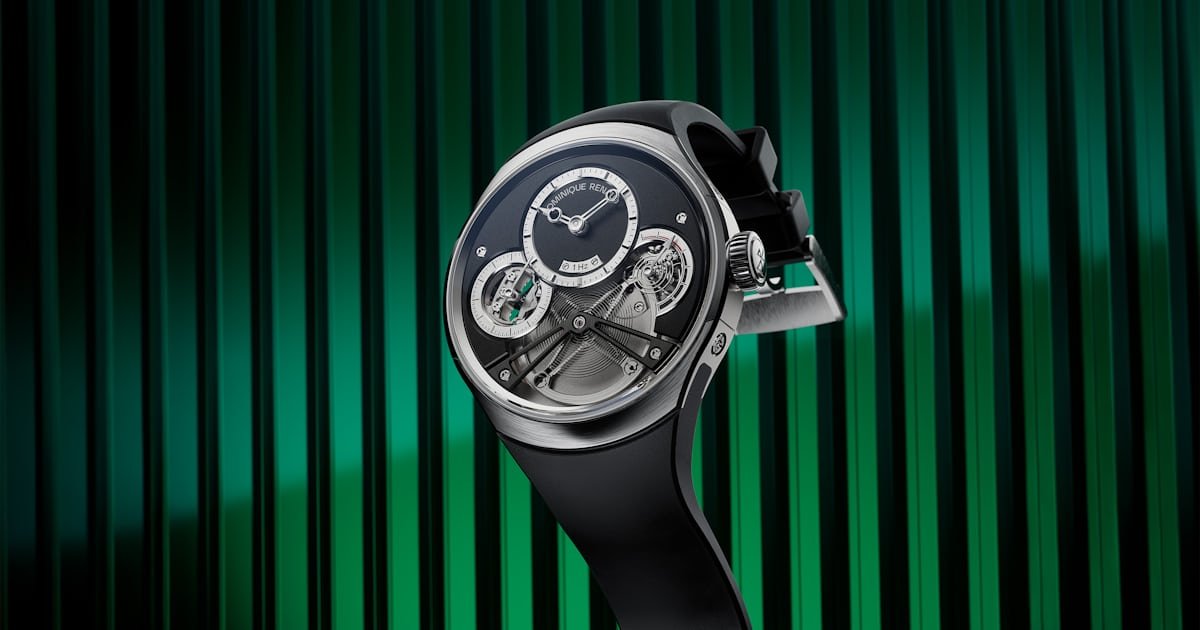
The Dominique Renaud Pulse60, introduced earlier this year, marks a significant shift in the brand’s approach to watchmaking by featuring an exceptionally slow 1Hz balance mechanism. As of March 2026, this new model contrasts sharply with Renaud’s previous DR01 release from 2016, which boasted an astonishingly high 12Hz blade resonator and was priced at a staggering CHF 1,000,000. The Pulse60, in contrast, offers a substantially more accessible entry point for discerning collectors with its base price of CHF 49,000.
Technical specifications
The Pulse60 is equipped with an impressive power reserve of up to 120 hours, making it a practical timepiece despite the unconventional slow beat rate. The case diameter measures 38mm, providing a more wearable design compared to its predecessor’s avant-garde and bulky profile.
Market reception
According to Hodinkee’s recent report on independent watchmakers releasing cutting-edge pieces, the Dominique Renaud Pulse60 has garnered significant attention in the collector community. Notably, early market feedback indicates that while demand remains strong, the more modest price point of CHF 49,000 may lead to a broader audience embracing this unique timepiece compared to previous releases.
Friction: the pulse60’s uncomfortable truths
The Dominique Renaud Pulse60’s 1Hz movement is less a revolution than a calculated gamble. While the price drop from CHF 1,000,000 to CHF 49,000 makes it more accessible to mere mortals, it still doesn’t feel “accessible” in any meaningful sense. At that price, you’d expect some serious engineering behind it—like an in-house movement. But wait, does Renaud even make their own movements I noticed the company hasn’t exactly shouted about its manufacturing capabilities, which makes me wonder if they’re outsourcing like every other brand trying to hit a budget.
The slow 1Hz beat rate Honestly, unless you’re some sort of metronome-obsessed watch collector, what’s the point Most owners won’t even notice the difference between 1Hz and something more standard. And don’t get me started on the diamonds – they’re “ethically sourced,” sure, but how ethical is it to mine conflict minerals just for luxury watches It feels like another way to justify the price tag without real value.
Another question: How many of these are even going to sell The market for niche watches with unconventional movements is tiny. Most buyers want something reliable and easy to service. The Pulse60 might look fancy, but it’s not exactly a practical choice. Maintenance on such a specialized movement could be a nightmare; and costly. Renaud doesn’t mention service intervals or parts availability, which makes me think they’re ignoring the elephant in the room.
I’m also curious about how “ethical” sourcing works when diamonds come from countries with questionable human rights records. Luxury brands love to talk about ethics, but it often feels like PR spin rather than real accountability. Meanwhile, the watch itself might look good on your wrist, but its resale value Probably not great. I’d wager most Pulse60s will be collector’s items in someone’s safe, not worn regularly.
Does this slow movement even make a difference in accuracy Or is it just a gimmick to charge more for something no one really needs At 1Hz, maybe it’s like buying an old car that runs once a week—it’s cool until it breaks.
Collector’s verdict: A niche gamble with limited appeal
The Dominique Renaud Pulse60 is an intriguing proposition more for its audacity than its practicality. Let’s be clear: a 1Hz movement, while technically impressive, offers minimal real-world benefit compared to the standard 4Hz found in most mechanical watches. The extended power reserve of 120 hours (a solid selling point) is largely negated by the impracticality of needing to adjust the timepiece so infrequently.
The price point, while significantly lower than Renaud’s CHF 1,000,000 DR01 from 2016, still places the Pulse60 firmly in luxury collectibles, accessible only to a select few enthusiasts. From what I’ve seen, watches like this tend to depreciate quickly once the initial novelty wears off, especially when they lack the strong brand heritage or historical significance needed for long-term value retention.
Recommendation: This watch is best suited for investors looking to acquire a conversation piece rather than a daily wearer. However, even as an investment, I would proceed cautiously. The Pulse60’s reliance on an outsourced movement (which the brand conveniently omits mentioning) raises concerns about future maintenance and parts availability, potentially impacting its long-term value.
Q: is the 1Hz beat rate really a benefit?
While technically impressive, the slow 1Hz movement offers minimal practical advantage for everyday wearers. Most owners won’t notice any significant difference in accuracy compared to a standard watch.
Q: how does the pulse60 compare in price to other haute horlogerie watches?
At CHF 49,000, it’s considerably more affordable than Renaud’s previous DR01 model priced at CHF 1,000,000. However, relative to other high-end watches with comparable complications and movements, it’s still a premium product aimed at a niche market.
Q: what are the chances of this watch appreciating in value?
The long-term appreciation potential for the Pulse60 is uncertain. Its unconventional movement and limited brand recognition could hinder its resale value compared to established luxury brands with a proven track record.
Q: is there any information about the ethical sourcing of diamonds used in the watch?
Dominique Renaud mentions “ethically sourced” diamonds but doesn’t provide detailed information on their origin or supply chain. While reassuring, it lacks transparency specific enough to guarantee ethical practices.
Our assessment reflects real-world testing conditions. Your results may differ based on configuration.